

- News
- Reviews
- Bikes
- Components
- Bar tape & grips
- Bottom brackets
- Brake & gear cables
- Brake & STI levers
- Brake pads & spares
- Brakes
- Cassettes & freewheels
- Chains
- Chainsets & chainrings
- Derailleurs - front
- Derailleurs - rear
- Forks
- Gear levers & shifters
- Groupsets
- Handlebars & extensions
- Headsets
- Hubs
- Inner tubes
- Pedals
- Quick releases & skewers
- Saddles
- Seatposts
- Stems
- Wheels
- Tyres
- Tubeless valves
- Accessories
- Accessories - misc
- Computer mounts
- Bags
- Bar ends
- Bike bags & cases
- Bottle cages
- Bottles
- Cameras
- Car racks
- Child seats
- Computers
- Glasses
- GPS units
- Helmets
- Lights - front
- Lights - rear
- Lights - sets
- Locks
- Mirrors
- Mudguards
- Racks
- Pumps & CO2 inflators
- Puncture kits
- Reflectives
- Smart watches
- Stands and racks
- Trailers
- Clothing
- Health, fitness and nutrition
- Tools and workshop
- Miscellaneous
- Buyers Guides
- Features
- Forum
- Recommends
- Podcast
TECH NEWS
 Tech of the Week 8/8/2025 (credit: road.cc)
A £115 clip-on power meter that claims "pro-level" accuracy is set to hit Kickstarter, plus Trek's "industry-first shift" to low-emission aluminium, a fancy new Chris King headset patent + more
It's that time of the year that in the cycling world is all a bit after the Lord Mayor's show. We've had both editions of the Tour de France and all the bike tech goodness that comes in the build-up, now everyone's looking around wondering what's next. Thankfully for Tech of the Week the bike industry never fully stops and we've rustled up a few things worth knowing about for our latest round-up.
A £115 clip-on power meter that claims "pro-level" accuracy is set to hit Kickstarter
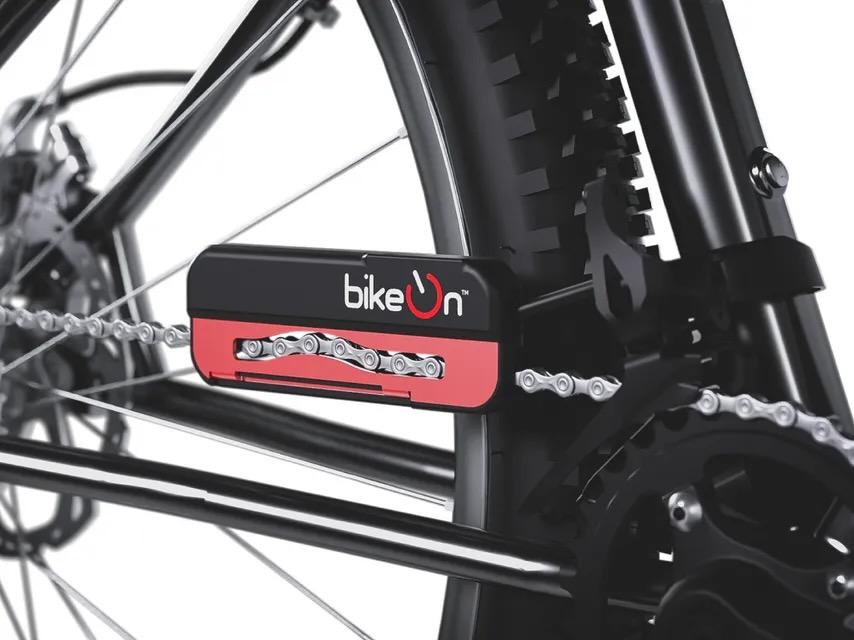 2025 BikeOn Cycleclick - 1 (credit: BikeOn)
Let's start with the 70g power meter that apparently fits to your chain in 30 seconds without any tools and provides power-reading accuracy to rival the established players. That's the claim of its makers — in fact BikeOn says it offers "pro-level" accuracy — the clip-on CycleClick power meter set to launch on Kickstarter soon.
You might remember we first spotted this back in March, the power meter now 'launching soon' on Kickstarter following an early access period elsewhere. That involved leaving a small refundable deposit to reserve "the lowest price ever" of $149, so we're assuming the Kickstarter number won't be that much more than that £115 asking price, although admittedly there currently aren't any package/pricing details.
> A 70g power meter with tool-free installation for £115? What's the catch?
The price is obviously a head-turner, the CycleClick way cheaper than most traditional power meters and even a fair bit below the now sub-£400 Favero Assioma Uno pedal-based device which currently sits at the bottom end of the power price range.
But will it actually do the job? Naturally, we said we'd approach the launch with caution when we first reported on it back in the spring and nothing's changed on that front. However, that's also not to say we're dismissing it outright or not incredibly excited to test it in the real world.
The CycleClick's makers say it is the "world's first chain-mounted power meter that actually delivers" and claim it offers "pro-level accuracy". There's a built-in chain speed sensor, full-bridge strain gauges and "advanced algorithms" to deliver "unmatched accuracy" of real-time power data. There's certainly also no shortage of confidence or big claims, CycleClick also suggesting it will provide stable readings in any weather and delivers on price, ease of installation, durability and precision compared with traditional power meters. As we've said, we're really looking forward to trying it, but you probably don't want to get too ahead of yourself reading Kickstarter campaigns.
It works with any chain-driven bike and weighs 70g. There's a stated battery life of 30 hours, but that's rechargeable via USB-C and there's Bluetooth to upload your data to Training Peaks, Strava, Garmin Connect etc. The warranty is listed as a year and, of course, once it goes live on Kickstarter, all the usual disclaimers apply about the crowdfunding platform.
It fits onto your bike chain, held in place just by a ball and socket system that mounts in most cases to your front derailleur, and BikeOn reckons that CycleClick can detect your cadence and measure power up to 2,000w.
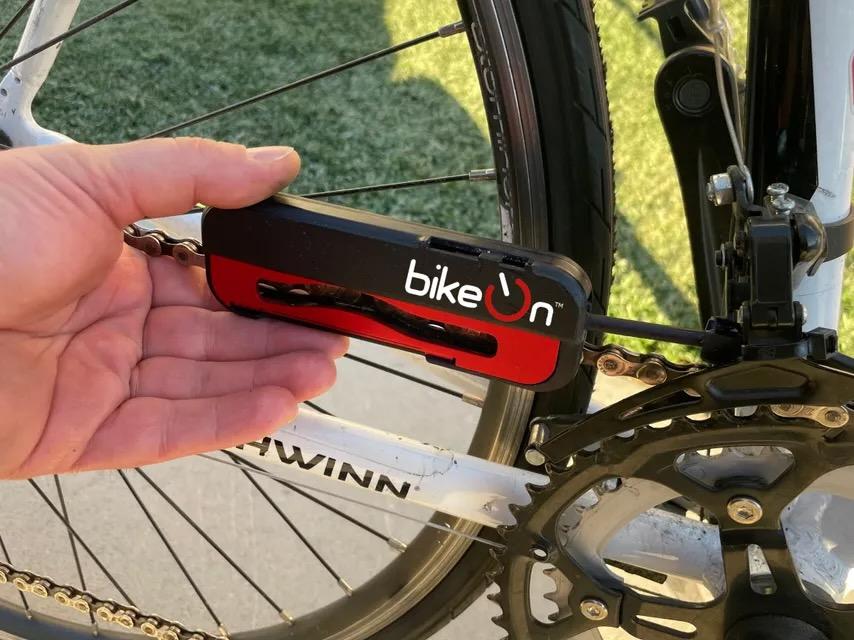 2025 BikeOn Cycleclick - 3 (credit: BikeOn)
Plenty of people on social media have been vocal about their doubts that the CycleClick could deliver accurate results, but BikeOn has come out fighting.
BikeOn co-founder Aram Novikov has said the the device is free to move laterally with the chain when you shift chainrings and that it will not come off easily. BikeOn also says that having a wet or dirty chain makes no difference to the results and that it doesn't matter whether the spring of your derailleur is heavy or light.
Will a bouncing chain affect things? BikeOn says that the CycleClick "becomes part of the chain" and will bounce itself.
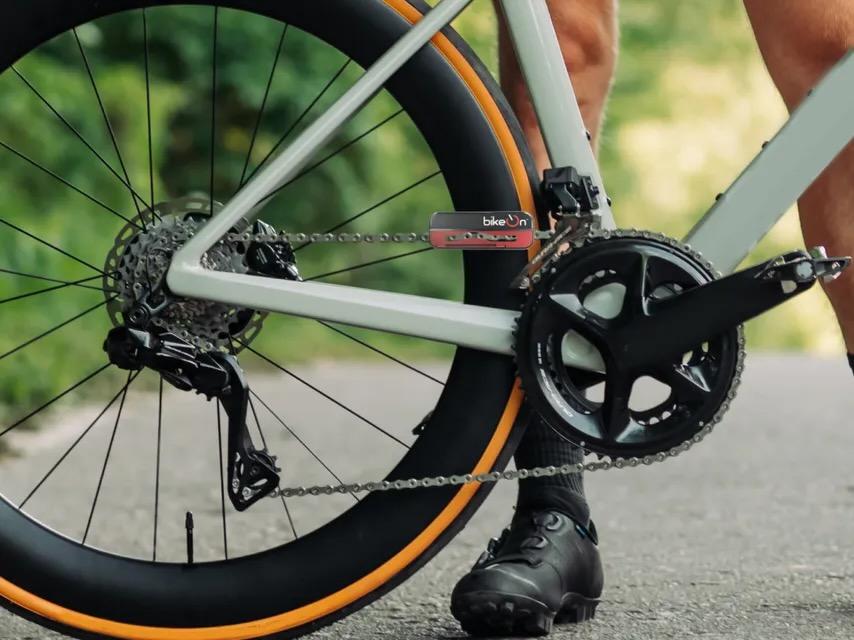 2025 BikeOn Cycleclick - 2 (credit: BikeOn)
"It can bounce, but because it's so lightweight, the bouncing does not affect the measurements," says Novikov. "It does not introduce any significant noise. If the device bounces on the chain, it indicates there is no tension and no power to measure.
"Some people say there are too many variables on a moving chain for these [measurements] to be accurate," Novikov continued. "It depends on how you design it. The device becomes part of the chain. It's very lightweight, and forces acting on the device are very small. So no, there are not too many variables. We measure the tension, we measure the speed of the chain, all the movement… It's all accounted for."
The Kickstarter page says it is 'launching soon' so hopefully we'll have some real-world testing and answers for you soon. For now, here's a link to all the info.
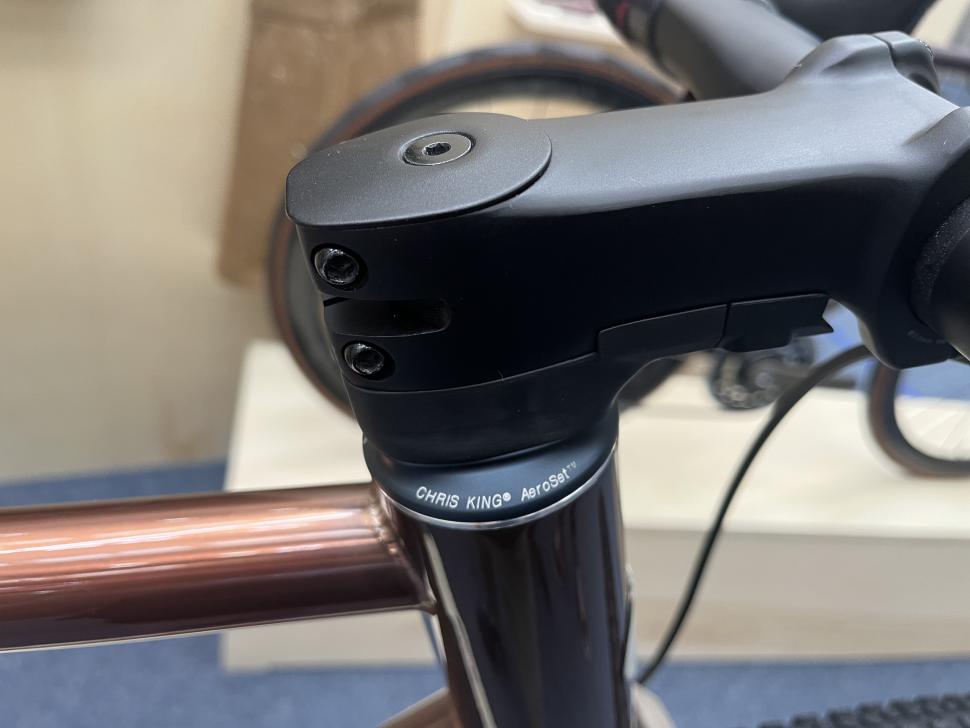
Chris King patents AeroSet internal headset design
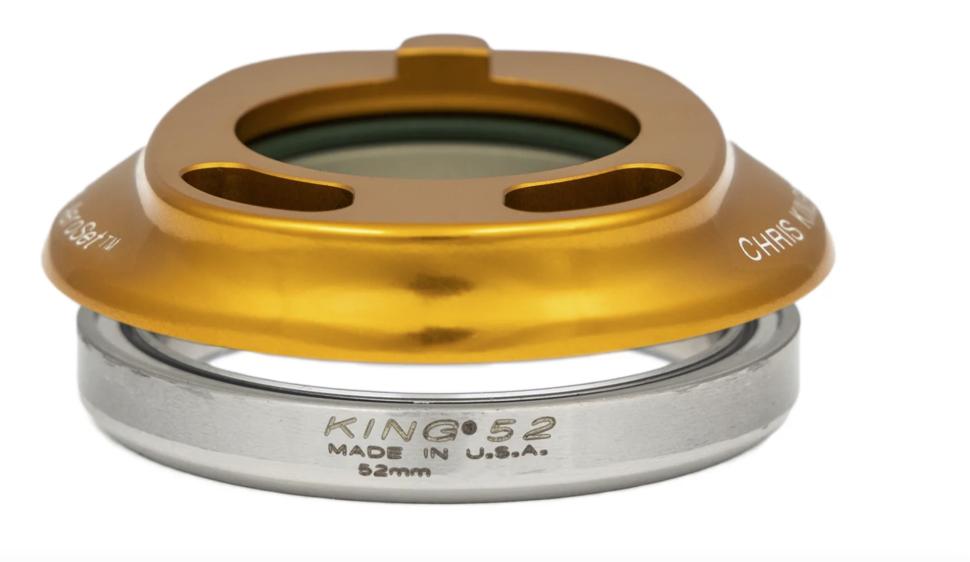 Chris King aeroset headset (credit: road.cc)
The United States Patent and Trademark Office has awarded Chris King Precision Components a patent for its internal headset design. Speaking about the development the company accepted that it was not the first to explore internal cable routing, but suggesting that it "recognised early on the value of creating the best possible version of an internal headset".
 Bespoked 2022 Chris King aeroset.jpeg (credit: road.cc)
You probably don't need us to tell you that working on internally routed cables can be time consuming (and therefore more costly if you're paying someone else to do it). In short, the Chris King now-patented design uses the brand's GripLock bearing cap system (a patented product in its own right) to create "the ultimate internally routed cable headset".
Chris King says the system resists loosening under demanding use, features bearings designed for "unmatched longevity", and remains easy to service over time.
Greg Hudson from Chris King said the patent "reflects our commitment to designing components that make modern bikes better to ride and easier to live with".
"British, not beige": Fancy a new Brooks colour?
Brooks saddles are now available in this rather lovely new teal colourway... "anything but beige".
Trek to use low-emission aluminium in "industry-first shift"
 2024 Trek Domane AL 4 - 1 (credit: Trek)
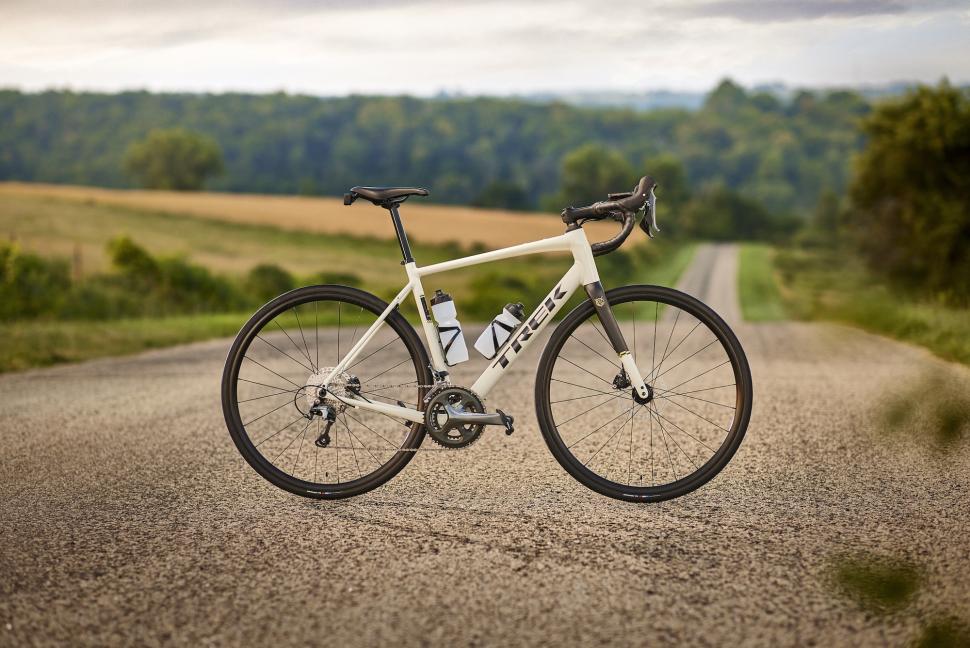
Trek has announced that from October "nearly every" aluminium bike frame from Trek, Electra and Diamant will be made using aluminium sourced from facilities powered by renewable energy, and/or incorporating recycled material.
The brand says this will affect well over 1 million bikes a year and is the largest carbon-reduction initiative in Trek's history. It marks a major milestone on the company's path to meeting its SBTi-certified climate goals ahead of schedule and is, Trek says, one of the most significant sustainability milestones the cycling industry has seen.
"This is a major move, not just for Trek, but for what's possible in bicycle manufacturing," said Trek President John Burke. "It'll put us years ahead of our climate goals, and it proves there's a better path. We hope other companies will join us, inside and outside of the bicycle industry."
And finally... get a load of Pauline Ferrand-Prévot's obligatory yellow Cervélo
 Pauline Ferrand-Prévot yellow Cervélo (credit: Cervelo)
In case you missed it:

Dan is the road.cc news editor and joined in 2020 having previously written about nearly every other sport under the sun for the Express, and the weird and wonderful world of non-league football for The Non-League Paper. Dan has been at road.cc for four years and mainly writes news and tech articles as well as the occasional feature. He has hopefully kept you entertained on the live blog too.
Never fast enough to take things on the bike too seriously, when he's not working you'll find him exploring the south of England by two wheels at a leisurely weekend pace, or enjoying his favourite Scottish roads when visiting family. Sometimes he'll even load up the bags and ride up the whole way, he's a bit strange like that.
Latest Comments
- Miller 9 min 26 sec ago
Nice clip but ambient sound would have been much better than some tired old rock thing.
- sigirides 10 min 44 sec ago
If the focus is on cyclists, then it's not speeding they have a problem with, it's cyclists. https://www.youtube.com/watch?v=vFMkYA7s58M
- Mr Blackbird 16 min 26 sec ago
I agree. I would be fed up if an MP I had voted for changed parties mid term. However in this case, he isn't currently representing anybody. He...
- chrisonabike 54 min ago
But but we've always had fires, and in particular much of Australia is a "fire-prone" environment! "Firestick farming" may have been a major...
- Backladder 2 hours 30 min ago
Frequent 502 and 404 errors this morning so its not looking good at the moment.
- WhichWayNow 12 hours 55 min ago
I had some rim brake CLX50 in 2017 that had 21mm internal width. Very few wheels are coming with a 21mm internal width these days. That's why I...
- Another_MAMIL 42 min 25 sec ago
What has happened to clothing prices?
- LeadenSkies 15 hours 50 min ago
Wogan Junior's comments show the dangers of leaving far too much money to your kids. The bloke thinks he is somehow a celebrity. He wishes. Don't...
- j4m1eb 16 hours 7 min ago
I was amazed that it was included in my membership and to top it off somehow I manged to pay via my iphone and therefore paid £3.99!
Add new comment
6 comments
"pro-level accuracy" North sea oil rig level chainrub noise
Given the large amounts of skepticism on the power meter's launch it would clearly be a priority to get the device into the hands of some reviewers. I've had a look around and I can't see any sign of reviews from cycling journalists which is a pretty big red flag on its own in addition to many others.
The product follows the classic failed Kickstarter with unsubstantiated claims about a revolutionary new product which is better and cheaper, in fact it's uncanny how similar the Cycleclick campaign page is to the IQSquared power meter campaign page which of course was a complete failure. All that's missing is testimony from major websites which is misleadingly placed to look like an endorsement despite the fact there's been no review units.
Even if the power meter did work the design looks finicky sitting on the chain like that and whlie it has a number of limitations, I'd still choose my left crank based power meter.
There are several mentions on the website of the device's ability to measure L-R power balance although in the FAQ it says that "with the optional magnet accessory, you can track left/right distribution to spot imbalances and train smarter", so not quite.
It can estimate it but the estimate would have to make assumptions about the power phase of each leg being less than 180 degrees and the rider not pushing and pulling at the same time which are going to be wrong some or most of the time. Perhaps it is only relates to peak power? In any case it can't/won't have the accuracy of for example a double-sided crank or pedal power meter and for me this does cast doubts on the device as it suggests the developers need a better understanding of the pedal stroke.
Trek. It is a great an effort to be applauded, and I do honestly believe them to be better than most in the industry with their work. However, why such crap corporate speak about being "years ahead of our target"? Surely, either the goals were stupidly low or it's a great opportunity to go even further in their ambition?
That Brooks needs copper rivets, then it's a winner.
Riese & Mullet have been using recycled aluminium for a while. https://www.r-m.de/en-gb/magazine/impact-recycling-aluminium
Good on Trek for also realising this.